What Is Net 30? Payment Terms Explained
Net 30, Plain English
Picture this: you finish a consulting job on June 1, send the invoice that afternoon, and your client's accounts payable team receives it the next morning. When does the money arrive? Under Net 30 terms, they have until July 1 to pay. The full balance, in one payment, by day 30 from the invoice date — not from when they opened the email, not from when they approved it internally. From the date on the invoice.
The word "net" refers to the total amount owed after any deductions. It doesn't mean net business days, net working days, or anything involving a calendar adjustment. Thirty calendar days, including weekends and bank holidays.
Net 30 is the most common payment term in B2B transactions because it fits the rhythm of how most companies process invoices. An AP team receives an invoice, routes it for budget approval, schedules it in the next payment run (often biweekly), and cuts the payment. Net 30 gives that cycle room to complete without forcing either side to scramble.
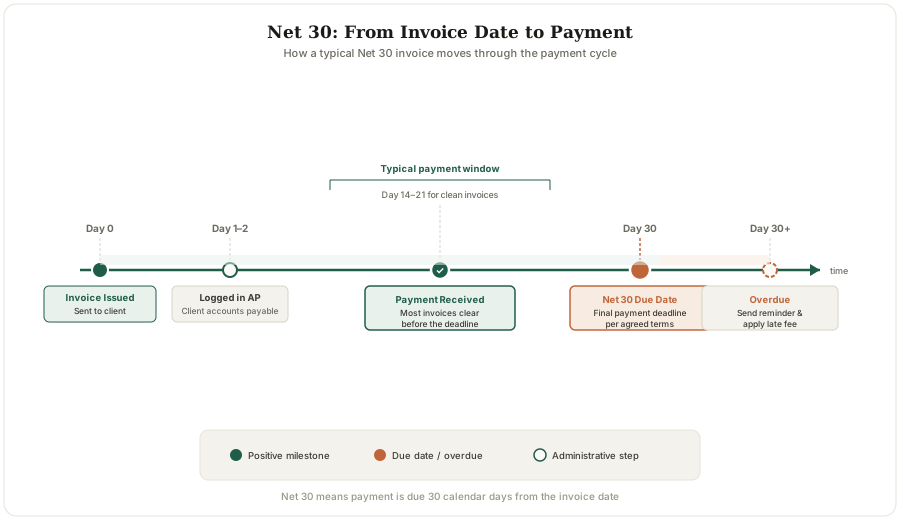
Net 30 in practice: the deadline is day 30, but clean invoices usually clear well before it.
How Net 30 Actually Works Day-to-Day
In the scenario above, the client's AP team logs the invoice, routes it for approval, and schedules it on their next payment run. If they run payments biweekly on the 1st and 15th, you'll likely see the money around June 12-15. That's the ideal case.
In reality, most Net 30 invoices settle somewhere between day 25 and day 34. A clear, complete invoice with no missing PO number or mismatched billing address lands on the early side. One that triggers a question adds roughly a week. Net 30 sets the expectation; actual behaviour clusters around it.
One thing worth internalising: Net 30 is a deadline, not a target. Many clients pay in 14-21 days when the invoice is clean. Don't assume you're waiting the full month.
And to be clear about what those 30 days are: Net 30 counts calendar days, not business days, so weekends and holidays are included. If the 30th day lands on a Sunday, payment is generally expected the following Monday.
Comparing Net 30 to Other Common Terms
Here is how the standard terms stack up:
| Term | Due In | Best For | Cash Flow Impact |
|---|---|---|---|
| Due upon receipt | Immediately | Retail, new clients, small amounts | Fastest cash in |
| Net 15 | 15 days | Freelancers, small businesses | Fast, good for solo operators |
| Net 30 | 30 days | Most B2B relationships | Standard; balanced |
| Net 45 | 45 days | Mid-size clients with slower AP | Moderate delay |
| Net 60 | 60 days | Enterprise and government | Significant delay; price it in |
| Net 90 | 90 days | Manufacturing, wholesale | Major cash flow drag |
A practical rule if you're a solo freelancer: start with Net 15. You can always extend terms for a client who has proven they pay on time. Going the other way — tightening terms on a client accustomed to Net 30 — is a much harder conversation.
Early Payment Discounts: 2/10 Net 30
"2/10 Net 30" means: pay within 10 days, take 2% off. Otherwise, the full amount is due in 30 days.
On a $10,000 invoice, that's $200 in savings for paying 20 days early. Annualised, that 2% discount over 20 days is roughly a 36% return on the buyer's capital. Financially alert AP departments will almost always take it.
From your side, you give up $200 but collect three weeks sooner. Whether that trade is worth it depends on your margins and how tight your cash flow is. With healthy margins, $200 to accelerate a $10,000 payment by 20 days is usually a good deal. On thin-margin work, do the arithmetic first.
Other common variations: 1/10 Net 30 (1% discount) and 3/10 Net 60 (3% for paying 50 days early). The structure is always the same: discount percentage / qualifying days, then the full net term.
When Net 30 Isn't the Right Choice
Net 30 is the default, not the universal answer.
For new clients you haven't worked with, Net 30 is a full month of unsecured credit extended to someone with no payment track record. "Due upon receipt" or a 50% deposit with Net 15 on the remainder is a safer starting point.
For large corporate clients, the dynamic often flips. Many Fortune 500 companies run on Net 60 or Net 90 and won't negotiate. If you want their business, those are the terms. Factor the cash flow delay into your pricing.
For retainer arrangements, monthly invoicing on Net 15 keeps things predictable. Net 30 on a monthly retainer means you're perpetually a month behind, which compounds quickly over a long engagement.
Our full payment terms reference covers every standard term and the situations where each one makes sense.
What to Do When a Client Misses the Deadline
Day 31, no payment. Here's a sequence that works:
Days 1-7 past due: send a short, friendly email. "Just a quick follow-up — Invoice #INV-2026-042 was due on July 1. Let me know if you have any questions." Most late payments are oversights, not refusals.
Days 8-14: follow up again, slightly more direct. Reattach the invoice. Copy your main contact if you've been corresponding with AP directly.
Days 15-30: call or send a direct message. Ask if there's a problem with the invoice or the work. Invoices genuinely get lost in email more often than you'd expect.
Day 30 past due: formal overdue notice referencing your contract's late-fee clause. This is exactly why having a signed contract with late-payment terms matters. In the UK, statutory interest under the Late Payment of Commercial Debts Act is 8% plus the Bank of England base rate for commercial debts. In the US, rates are set by state law (typically 1-2% per month if disclosed upfront).
Day 60 or more: final demand letter, mediation, or collections. A letter from a solicitor (UK) or attorney (US) resolves a surprising number of disputes at this stage.
For prevention strategies, see 9 proven tips to get invoices paid faster.
Displaying Net 30 on the Invoice
Put it in two places. In the header, near the dates: "Payment Terms: Net 30 | Due Date: July 1, 2026." This is for the AP clerk who processes dozens of invoices a day and needs the term and deadline at a glance. In the notes at the bottom: "Payment is due within 30 days of the invoice date." This is for whoever actually reads the invoice and may not know what "Net 30" means.
Our invoice generator includes both fields by default.
Keep reading
Can You Change an Invoice After Sending It? How to Correct Invoice Mistakes
Once an invoice is sent you shouldn't silently edit it. Here's how to void, reissue, or use a credit note to fix wrong amounts, clients, or tax.
8 min readDocument TypesWhat Is a Debit Note? Debit Note vs Credit Note Explained (+ Free Template)
A plain-English guide to debit notes: who issues them, when a buyer or supplier uses one, how they differ from credit notes and invoices, plus a free template.
8 min read