What Is a Commercial Invoice? Customs Requirements + Free Template
Is a Commercial Invoice the Same as the Invoice You Send for Payment?
No, and confusing the two is a common and expensive mistake. A commercial invoice is a legal customs document — not a payment request, not a preliminary quote. It tells the authorities at a border crossing what's in the shipment, who's sending it, who's receiving it, what it's worth, and where it was made. Customs uses that information to calculate duty and tax, verify the goods against import rules, and decide whether the package moves through or sits in a bonded warehouse accumulating storage charges.
Your standard sales invoice is a payment request to a client. A proforma invoice is a preliminary quote issued before goods ship. A commercial invoice is the final, definitive record of the transaction, prepared specifically for export and import. For a single international sale, you may issue all three: a proforma to confirm the order, a commercial invoice for the shipment, and your accounting invoice for the books.
If you sell physical products internationally — an Etsy seller posting handmade goods, a small manufacturer shipping a pallet, a freelancer mailing prototype hardware — you'll need one for nearly every commercial shipment that crosses a border. DHL, FedEx, UPS, and most carriers require it and won't let you book international freight without one.
When You Need One (and When You Don't)
You need a commercial invoice when goods of commercial value cross an international border. That includes sales, free samples, warranty replacements, and goods shipped between two branches of the same company.
You generally don't need one for:
- Documents only — paper with no commercial value (a signed contract, printed reports).
- Domestic shipments — anything staying inside one customs territory.
- Personal gifts below a de minimis threshold — though "gift" status is scrutinised, and thresholds vary by country and change frequently. Don't mislabel a sale as a gift to dodge duty; that's customs fraud.
For very low-value items, some carriers accept a simplified declaration, but the safe default for any business shipment is a full commercial invoice.
Required Fields, One by One
Customs forms vary slightly by carrier and destination country, but the core data is consistent. Get any of these wrong and your package can be held, fined, returned, or destroyed.
Shipper and consignee details
Full legal name, address, phone, and email for both the sender (shipper/exporter) and the recipient (consignee/importer). If the buyer differs from the delivery address, list both. Include tax and business identifiers where required: an EORI number for UK and EU shipments, an ABN for Australia, an importer's tax ID for the US.
Invoice number and date
A unique reference tying the document to your records. Use your normal sequence (see invoice numbering best practices) and the date the goods are shipped.
Detailed description of goods
Vague descriptions are the single most common cause of customs delays. "Gifts," "samples," "parts," or "merchandise" will get a shipment flagged. Describe what each item actually is, what it's made of, and what it's for.
Wrong: "Clothing — 10 pcs"
Right: "Women's knitted scarves, 100% merino wool, not embroidered — 10 pcs"
HS code (Harmonised System code)
The HS code is an internationally standardised number that classifies the product. The first six digits are the same worldwide; countries add further digits for their own tariff schedules (the US uses 10-digit HTS codes, the EU uses CN codes, the UK its own commodity codes). Customs uses this number to determine the duty rate.
You're responsible for classifying your own goods correctly. Find the right code through your country's tariff tool: the US International Trade Commission's HTS search, the UK Trade Tariff tool, the Canada Customs Tariff, or Australia's Working Tariff. A wrong code can mean underpaid duty (and penalties) or overpaid duty (money you don't get back easily).
Example: a stainless steel water bottle might classify under HS 7323.93. The first six digits work globally; your destination country appends its own suffix.
Country of origin
Where the goods were manufactured or produced, not where you're shipping from. A bottle made in China but shipped from your warehouse in Manchester has a country of origin of China. Origin determines eligibility for trade agreements and preferential duty rates, so it matters financially.
Quantity, unit value, and total value
List quantity per line, the unit price, and the line total, then a grand total. Show the currency clearly (USD, GBP, CAD, AUD, EUR). Include the weight per item where the form asks.
Declared (customs) value
The value customs uses to calculate duty. For a straightforward sale, this is the price the buyer pays. For free samples or replacements, you still declare a fair market value and usually mark "no commercial value — value for customs purposes only." Never undervalue to reduce duty. It's illegal, it voids your shipping insurance (claims pay out against declared value), and customs can revalue goods and fine you.
Incoterms
Incoterms (International Commercial Terms, published by the ICC) define exactly where the seller's responsibility ends and the buyer's begins — who pays freight, who pays duty and import tax, and who carries risk at each stage. State the term and the named place.
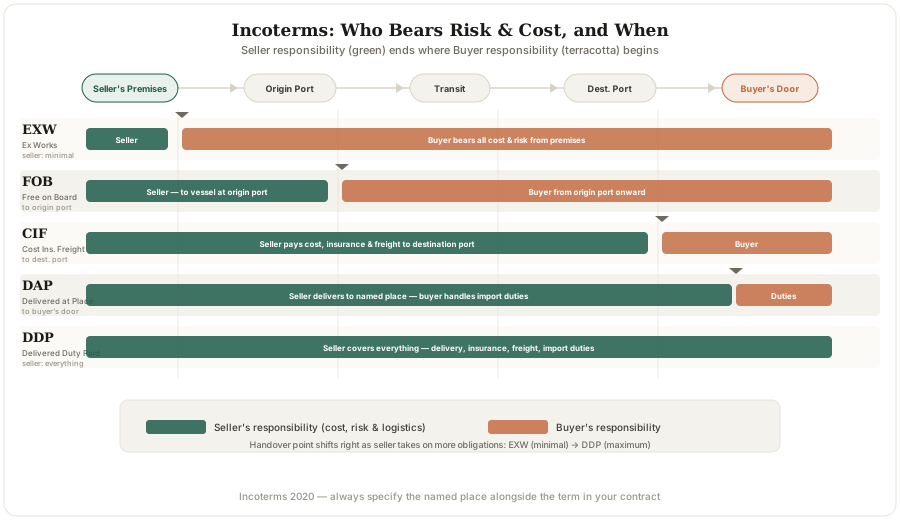
Incoterms at a glance: how far the seller's responsibility reaches under each term.
Common terms for smaller shippers:
- EXW (Ex Works) — buyer collects from your premises and handles everything after. Minimum seller obligation.
- FOB (Free On Board) — seller delivers to the port and loads the vessel; risk passes to the buyer there. Used for sea freight.
- CIF (Cost, Insurance, Freight) — seller pays freight and insurance to the destination port; buyer handles import.
- DAP (Delivered At Place) — seller delivers to the buyer's address; buyer pays import duty and tax.
- DDP (Delivered Duty Paid) — seller handles everything, including destination duty and tax. Best buyer experience, most cost and admin for you.
Pick one deliberately. If you ship DDP without budgeting for the destination duty, you absorb a bill you didn't price in. If you ship DAP, tell your buyer they'll receive a duty invoice from the courier before delivery — surprise charges lead to refused parcels.
Reason for export
A short statement: "Sale of goods," "Sample — no commercial value," "Repair and return," "Gift." This affects how the shipment is treated at the border.
Signature
Many destinations require the exporter to sign and date the invoice, certifying the information is accurate. An electronic signature is usually accepted.
A Worked Example
Say you run a small ceramics studio in Bristol shipping a wholesale order to a boutique in Toronto.
Commercial Invoice #2026-0417 — Date: 23 Jun 2026
Shipper: Clayfield Studio Ltd, 14 Kiln Road, Bristol BS1 4AB, UK — EORI GB123456789000 Consignee: Maple & Co Boutique, 88 Queen St W, Toronto ON M5H 2M5, Canada
Description HS code Origin Qty Unit (GBP) Total Stoneware dinner plates, glazed, 27cm 6912.00 UK 24 12.00 288.00 Stoneware mugs, glazed, 350ml 6912.00 UK 36 8.00 288.00 Subtotal: GBP 576.00 Freight: GBP 45.00 Total declared value: GBP 621.00 Incoterms: DAP Toronto Reason for export: Sale of goods Total gross weight: 18.5 kg Signed: ___________
Under DAP, Maple & Co pays Canadian import duty and GST/HST before the courier releases the parcel. Clayfield should tell them that upfront. Note that VAT is generally zero-rated on exported goods, but you must keep proof of export — confirm the rules in our UK VAT guide and check whether your sale affects your VAT registration position.
Tips That Prevent Delays
- Match everything. The values, quantities, and descriptions on the commercial invoice must match the shipping label, the packing list, and any customs declaration. Mismatches trigger inspections.
- Three copies. Couriers typically want the commercial invoice in a clear pouch on the outside of the box, often three signed copies. Many also require an electronic upload at booking.
- Use the buyer's tax ID when required. Canada, Australia, and the EU often need the importer's identifier for clearance.
- Round nothing suspiciously. Declared values that look invented — every item exactly £10 — draw attention.
- Keep copies for your records. Customs authorities can audit export documents years later. Store them with your accounting records.
For the underlying mechanics of building and formatting the document, see our guides on making an invoice in Excel, Word, or Google Docs and how to write an invoice. If you're also figuring out how to bill and get paid across borders, invoicing international clients covers the payment side.
Free Commercial Invoice Template: Fields to Include
Build your own by including every field below. Most carrier portals generate one automatically once you enter the shipment data.
- Document title: "Commercial Invoice"
- Invoice number and date
- Shipper: name, address, contact, EORI/tax ID
- Consignee: name, address, contact, importer tax ID
- Buyer (if different from consignee)
- Line items: description, HS code, country of origin, quantity, unit value, line total
- Subtotal, freight, insurance, grand total — with currency
- Total declared value for customs
- Incoterm and named place
- Reason for export
- Total number of packages and gross weight
- Exporter signature and date
Questions People Often Ask
What distinguishes a commercial invoice from a proforma invoice?
A proforma invoice is a preliminary document issued before the sale is final — a detailed quote that lets a buyer arrange payment or apply for an import licence. A commercial invoice is the final, binding record of the completed transaction, used by customs to clear the goods and assess duty. See our proforma vs invoice guide for the full comparison.
Do low-value shipments and samples still need a commercial invoice?
Usually yes. Even free samples and replacements need a commercial invoice that states a fair market value, with a note such as "sample — no commercial value, value for customs purposes only." Some carriers accept a simplified declaration below certain thresholds, but those thresholds vary by country and change over time, so confirm with your courier.
Who is responsible for getting the HS code and declared value right?
The exporter. You declare the information and sign to certify it's accurate. An incorrect HS classification or declared value can lead to penalties, delays, or seizure, regardless of whether a courier's platform helped fill the form. Use your destination country's official tariff tool and keep a record of how you arrived at each classification.
Is undervaluing goods to lower the customer's import duty ever acceptable?
No. Declaring a false value is customs fraud. It voids your shipping insurance (payouts are based on declared value), and customs can independently revalue your goods and fine both parties. Declare the true transaction value every time.
How do I choose the right Incoterm?
Start by deciding who is better placed to handle import logistics in the destination country — you or the buyer. If the buyer has a local freight forwarder and is familiar with their country's customs process, DAP is usually the simplest arrangement. If you want to offer a seamless delivered price and have the resources to handle destination duties, DDP gives the buyer the cleanest experience. Whatever you choose, communicate it clearly so neither side is surprised by an unexpected cost.
Keep reading
Can You Change an Invoice After Sending It? How to Correct Invoice Mistakes
Once an invoice is sent you shouldn't silently edit it. Here's how to void, reissue, or use a credit note to fix wrong amounts, clients, or tax.
8 min readDocument TypesWhat Is a Debit Note? Debit Note vs Credit Note Explained (+ Free Template)
A plain-English guide to debit notes: who issues them, when a buyer or supplier uses one, how they differ from credit notes and invoices, plus a free template.
8 min read